
Kilpeck Castle
HeritageKilpeck Castle: Nine Centuries on a Herefordshire Hill
Stand on the summit of Kilpeck's great mound on a still morning and the centuries fall away. Eight metres below, a deep ditch curls around the base like a dry moat drawn by a giant's compass. To the south-east, the tiny Church of St Mary and St David — one of the most celebrated Romanesque buildings in Britain — crouches among yew trees. Rooks wheel above fragments of masonry that once formed a polygonal shell keep, and somewhere beneath the turf lies a stone-lined well that once watered a garrison. This is Kilpeck Castle: a place where Norman ambition, royal intrigue, plague, and civil war have each left their mark on the red Herefordshire earth.
A Conqueror's Gift
Kilpeck's story begins in the Domesday Book of 1086, where the settlement appears under the name Chipeete. William the Conqueror granted the manor to a loyal follower, William fitz Norman, charging him with holding the turbulent Welsh borderland district of Archenfield. By around 1090, fitz Norman had raised a timber motte-and-bailey fortress on a low rise seven miles south-west of Hereford — a statement in oak and packed earth that Norman authority had arrived. The motte itself was formidable: roughly fifty metres across at its base, it commanded views across the Golden Valley and the Black Mountains beyond. A kidney-shaped inner bailey stretched eastward toward the settlement, shielded by a rampart along its northern and southern flanks. Two further outer baileys enclosed space for stabling, stores, and the domestic life of a frontier lordship.
From Timber to Stone
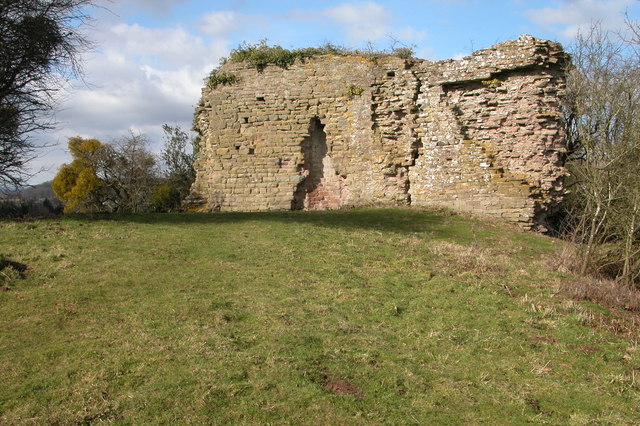
The castle's most transformative chapter belongs to Hugh de Kilpeck, William fitz Norman's descendant, who in the first half of the twelfth century replaced the ageing timber palisades with a polygonal shell keep in local sandstone. The walls — roughly two metres thick and standing five metres high even in ruin — enclosed domestic quarters fitted with a fireplace and chimney flues, a rare comfort in a Marcher fortress. A deep well sunk through the motte guaranteed water during siege. Hugh was also the likely patron of the extraordinary church just three hundred metres away, whose corbel table of grotesque carvings remains one of England's finest examples of Romanesque sculpture. In 1134, he founded a small Benedictine priory south-east of the church and donated the castle's revenues to sustain it, binding the spiritual and military life of Kilpeck into a single estate.

_(geograph_6834336).jpg)
Royal Guests and a Friday Market
By the early thirteenth century, Kilpeck had risen in status. In 1200, King John granted Hugh's grandson, John de Kilpeck, the bailiwick of all the forests of Herefordshire — an extraordinary mark of trust for a minor lordship. When John de Kilpeck died in 1204, the estates passed to his young son Hugh, with the powerful William de Cantilupe managing them as guardian. It was Cantilupe who hosted King John at the castle in 1211, 1212, and again in 1214. The repeated royal visits suggest a fortress that had grown beyond a border outpost into a residence of some comfort and prestige. In 1259, the Crown cemented Kilpeck's regional importance by granting a weekly Friday market and an annual fair — the hallmarks of a thriving medieval settlement.
Decline and Dissolution
Kilpeck's fall was not sudden but cumulative. The male line of the de Kilpeck family ended in 1248 when Hugh de Kilpeck died leaving only daughters. The castle passed through the Walerand and Plugenet families before reaching the Butlers, Earls of Ormond, by 1325. These were absentee lords with larger concerns in Ireland, and the garrison was withdrawn. Three years of famine followed; then, in 1348–49, the Black Death swept through the settlement and halved its population. The castle mouldered. The priory, its congregation dwindled, was dissolved around 1422. By the time John Leland rode through in the 1530s, only fragments of wall remained.


Kilpeck endured one last military episode during the English Civil War, when a Royalist garrison briefly occupied the site between 1635 and 1645. The castle was never attacked, but at the war's end Parliament ordered it slighted — its remaining walls deliberately broken to prevent future use. The act was largely symbolic; Kilpeck had already been a ruin for two centuries.
What Survives
Remarkably, quite a lot. The great motte still rises eight metres above its surrounding ditch, its profile largely unaltered since the eleventh century. Sections of the shell keep wall stand on the summit, their red sandstone pitted by nine hundred years of Herefordshire rain. The footprint of the fireplace and chimney flues can still be traced. In the inner bailey, the line of the rampart is clearly visible along the northern and southern edges. A 1982 excavation by the Hereford and Worcester County Council identified seven distinct archaeological periods within the site, recovering medieval pottery fragments, roof tiles, an iron spur, a knife blade, a buckle, and a grinding stone — the small, telling debris of daily life in a working fortress.


A Place of National Significance
Kilpeck Castle is a Scheduled Monument, protected by law as a site of national importance. Its significance lies not only in the surviving masonry but in the completeness of the earthwork plan: motte, inner bailey, outer baileys, and ditch together form one of the best-preserved Norman castle layouts in the Welsh Marches. Paired with the astonishing church next door — itself a Grade I listed building — Kilpeck offers an almost unbroken window into the Norman colonisation of the borderlands: the military, religious, and economic structures that a single lordship imposed on the landscape within a generation.
Visiting Kilpeck
The castle earthworks are freely accessible year-round and sit just off the A465, roughly twelve kilometres south-west of Hereford. A footpath climbs the motte from the churchyard, and the summit rewards the short, steep walk with sweeping views toward the Black Mountains and the Skirrid. The church is open daily and should not be missed — its south doorway alone, with its Tree of Life tympanum and dragon-carved columns, justifies the detour. There is limited roadside parking near the church, and the Red Lion inn in nearby Madley provides a welcome stop.
This article was partly inspired by a collection of old photographs and a handful of audio recordings that came to light when someone brought their personal memories to be digitised. Among them were faded snapshots of the castle motte taken decades ago, and it made us wonder what else might be out there — tucked into attics, filed in shoeboxes, forgotten at the back of old cupboards — connected to Kilpeck Castle and the community around it. If anyone holds old media linked to this remarkable place, services like EachMoment can help preserve them for future generations.